
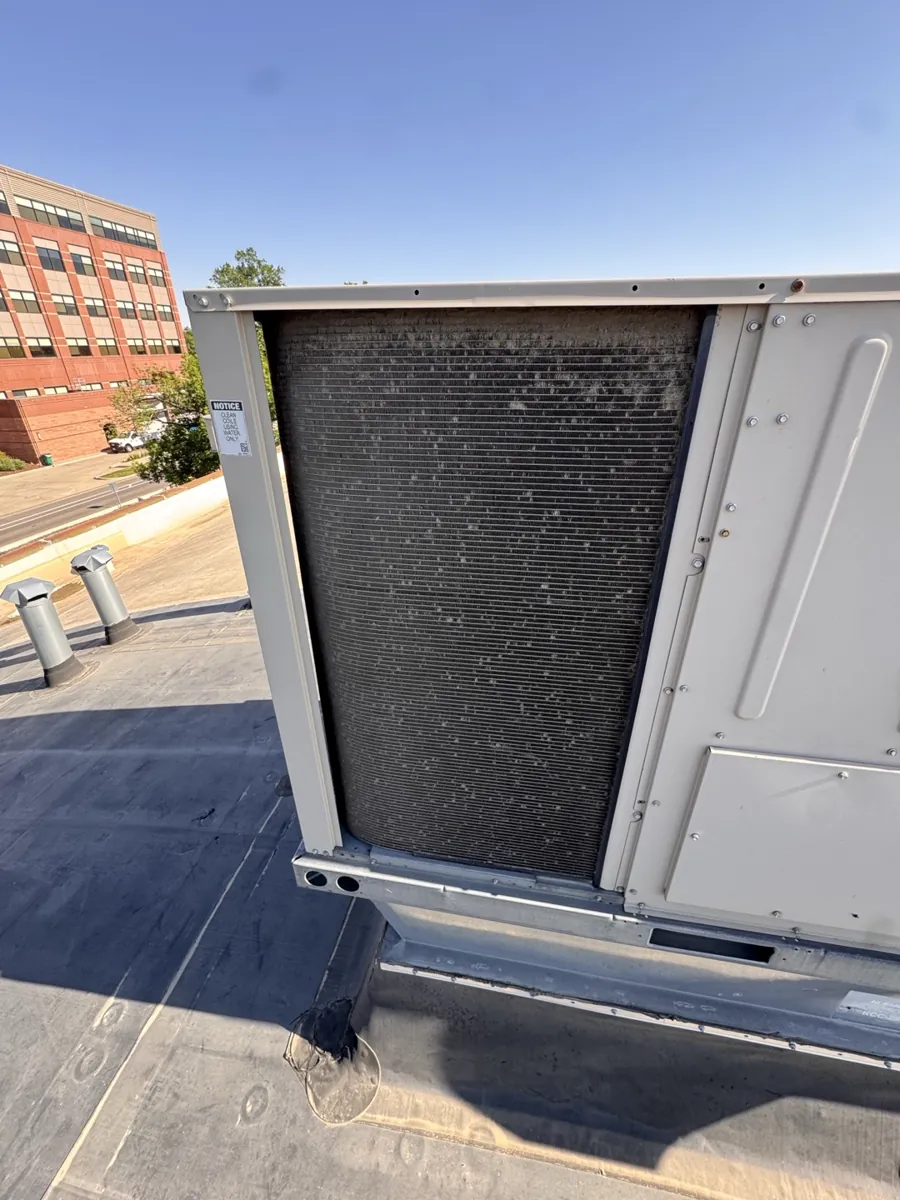
A rooftop unit not heating usually traces to one of five things: no call for heat at the thermostat, a gas or ignition fault, a limit switch trip from weak airflow, an economizer stuck open, or, on heat pump units, a defrost or backup heat problem. You can rule out a few from the ground.
The usual version goes like this. It is 6:30 on a January morning, the thermostat reads 54, and the fan is running. Air is coming out of the vents, but it feels like the parking lot. Someone has already turned the setpoint up to 80, which does nothing.
Why Is My Rooftop Unit Blowing Cold Air With the Fan Running?
The fan and the heat are separate jobs. On a gas unit, the thermostat calls for heat, a small inducer fan pulls combustion air through the burners, a switch proves that air is moving, the ignition control lights the burners, and a sensor confirms the flame. If any step fails, the burners stay off.
The big blower can keep running through all of that. With the thermostat fan set to ON instead of AUTO, it runs whether there is flame or not. A limit trip can start it too: York's installation manual says the limit shuts down ignition, closes the gas valves and turns on the blower.
So moving air tells you very little. Warm air is the only proof.
Techs work this chain in order, because each step only happens after the last one passes. An RTU not heating on a Trane looks a lot like one on a Carrier, Lennox, York or Daikin. The flash codes differ by brand and model, so we are leaving them out here. The chain is the same.
What Can You Check From the Ground?
Lennox's rooftop user manual lists the checks it wants done before a service call. These are the ones that fit an operator with no tools and no ladder:
- Thermostat: set to HEAT, setpoint above room temperature, and the schedule not stuck in an unoccupied setback. A blank screen is worth mentioning when you call.
- Breaker: look at the panel that feeds the unit. If one has tripped, reset it once. If it trips again, leave it off.
- Gas: if the range or the water heater is working, gas is probably reaching the building.
- One reset: on many units, moving the thermostat from HEAT to OFF and back clears a safety shutdown. Lennox gives that step for its standard units. Try it once.
- Filters: if yours sit at a return grille inside the building, change any that are due. Filters inside the unit are a rooftop job.
- Zones: note which rooms are cold. One zone points to one unit. The whole building points to gas, power or controls.
That is where the operator stops. We would rather you stay off the roof. Behind those panels are live power, moving fans and the gas train, and in January the roof itself may be iced.
If you smell gas, stop everything. Xcel Energy's guidance is to get everyone out, move a safe distance away, then call 911 and your gas company. Leave the light switches alone on the way out. If a carbon monoxide alarm sounds, or people get the headache and dizziness the CDC describes, get out and call 911 from outside. A cracked heat exchanger is one way combustion gases can reach the airstream.
Why Do the Burners Light and Then Shut Off?
Lighting and staying lit are two different tests. After the burners fire, a flame sensor has to read the flame. When that sensor is due for cleaning or has drifted, the control sees no flame and closes the gas valve, even with a healthy fire in the box. Lennox's manual says its units try up to two more ignitions before locking out. That lockout is why a building can go cold an hour after everything seemed fine.
An igniter that has worn out fails one step earlier. The inducer runs and nothing lights. The pressure switch sits ahead of both, and the same manual is plain about it: the gas controller will not operate if the inducer is obstructed.
Cold weather adds its own trouble. Drifted snow or ice can close off the combustion air inlet or the vent, and a rooftop unit needs an unobstructed flow of combustion air. Low gas pressure, a sticking gas valve and a failing control board can all look identical from the ground, which is why a tech meters each one before replacing anything.
Can a Plugged Filter Shut Off the Heat?
Yes, and it catches people off guard because the unit seems to heat for a few minutes first. The heat exchanger needs a steady stream of air across it. When airflow drops, the metal overheats and a limit switch shuts the burners down. York's manual blames inadequate supply airflow, and notes that its limit resets automatically. So a unit can fire, trip, cool off and fire again all day while the room never catches up.
The usual airflow causes:
- A filter due for changing. Lennox lists plugged filters in its pre-call checks, and another Lennox manual says to check filters monthly.
- A broken or slipping belt on a belt-drive blower.
- A failed blower motor.
- Closed supply dampers, or stock stacked against a return grille.
Treat a repeat trip as a warning with a cause behind it. Rollout switches are different again: on those, a trip means flame went somewhere it should not, and that calls for a tech every time.
Can a Stuck Economizer Make a Building Cold?
Yes. The economizer is the set of outdoor air dampers on the unit, and its job is free cooling on mild days. When a building is heating, PNNL's training guide says to use minimum outdoor air, and it questions any minimum position above 20%. The same guide lists the common failures: stuck dampers, damaged linkages, failed actuators, disconnected wires and bad sensors.
When those dampers stick open on a 10-degree morning, the burners can be working fine and still lose. The unit keeps pulling in far more cold air than it can warm. What you notice is lukewarm air at the vents and a building that never reaches setpoint, often with the unit running nonstop.
You cannot confirm this from the ground. Mention it when you call, especially if the burners seem fine or the cold gets worse on windy days. A tech checks the actuator, linkage and sensors, then drives the dampers closed to see if the supply air recovers.
Why Is My Heat Pump Rooftop Unit Not Keeping Up?
January is our busiest heating month, and heat pump units feel the cold first. Some of what looks like a fault is normal. Ice builds on the outdoor coil in cold, damp weather, so the unit runs a defrost. Carrier's 50JZ product data describes it as identical to cooling mode, except the outdoor fan stops and optional electric heat turns on to warm the air. A few minutes of steam off the unit and cooler air at the vents can be part of that.
These are not normal:
- Air at the vents stays cool for a long stretch, or the unit never seems to finish a defrost.
- The unit holds on a mild afternoon and falls behind every night. Backup heat may have failed, or the unit may not have any, since it is an option on some models.
- The thermostat shows auxiliary or emergency heat for hours at a time.
- The building cannot recover after a deep overnight setback.
The first three need a tech. The last one may only need a smaller setback, and a tech can tell you which.
What Should You Tell Dispatch When You Call?
A good first call can save a trip to the parts house. Have this ready if you can:
- The address, and which unit or zone is out. A roof with six units needs the right one.
- Make and model from your last service report or the unit tag.
- Gas heat, electric heat or heat pump, if you know.
- What the thermostat reads, what it is set to, and any code on the screen.
- What the air feels like: cold, lukewarm or nothing at all.
- Whether it quit all at once or keeps cycling on and off.
- What you already tried, including any breaker or reset.
- How cold the building is getting. Water lines near outside walls are the concern.
As for how fast the heat comes back, it depends on what failed. A flame sensor or igniter can often be handled on the first visit, since we carry common parts on the truck. A heat exchanger is a bigger conversation, and we do not return unsafe equipment to service.
Most of these faults give some warning, and a fall pre-season startup catches many of them. The cooling side gets the same treatment in our spring rooftop unit startup checklist. Restaurants can fold rooftop units into a plan that also covers refrigeration, and here is what a quarterly PM covers. Our commercial HVAC page has the full list of what we work on.
If the building is cold right now, call 970-686-8866 for commercial furnace repair. We answer 24/7/365. Lead with the thermostat reading and whether the air is cold or lukewarm.